
The moss stitch is one of the easiest ways to make a crochet blanket that looks far more advanced than it really is. It uses only two things you already know, the chain and the single crochet, yet the finished fabric has a neat, woven texture that lies flat, does not curl at the edges and hides small tension wobbles very well.
This is a technique guide rather than a fixed pattern. You will learn the stitch, how to work out your starting chain for any blanket size, how to estimate yarn by weighing, and how to keep the edges straight. If you have never made a blanket before, our guide on how to crochet a blanket for beginners explains planning and finishing in more detail.
This post contains affiliate links. As an Amazon Associate I earn from qualifying purchases, at no extra cost to you.
What Is the Moss Stitch in Crochet?
The crochet moss stitch is a simple repeat of one single crochet and one chain. On each new row the single crochet stitches sit inside the chain spaces of the row below, so the stitches stagger like bricks. That staggering is what creates the tiny, tweedy texture. You will also see it called the linen stitch, the woven stitch or the granite stitch, and they all describe the same basic idea.
For a first blanket, moss stitch has three real advantages. The fabric is dense, so it is warm and does not have big holes. It is reversible, so both sides look good on a sofa. And because each row is only single crochet and chains, it is very hard to get lost. The trade off is that it grows slowly, since single crochet is a short stitch, so a large blanket takes patience.
What You Need
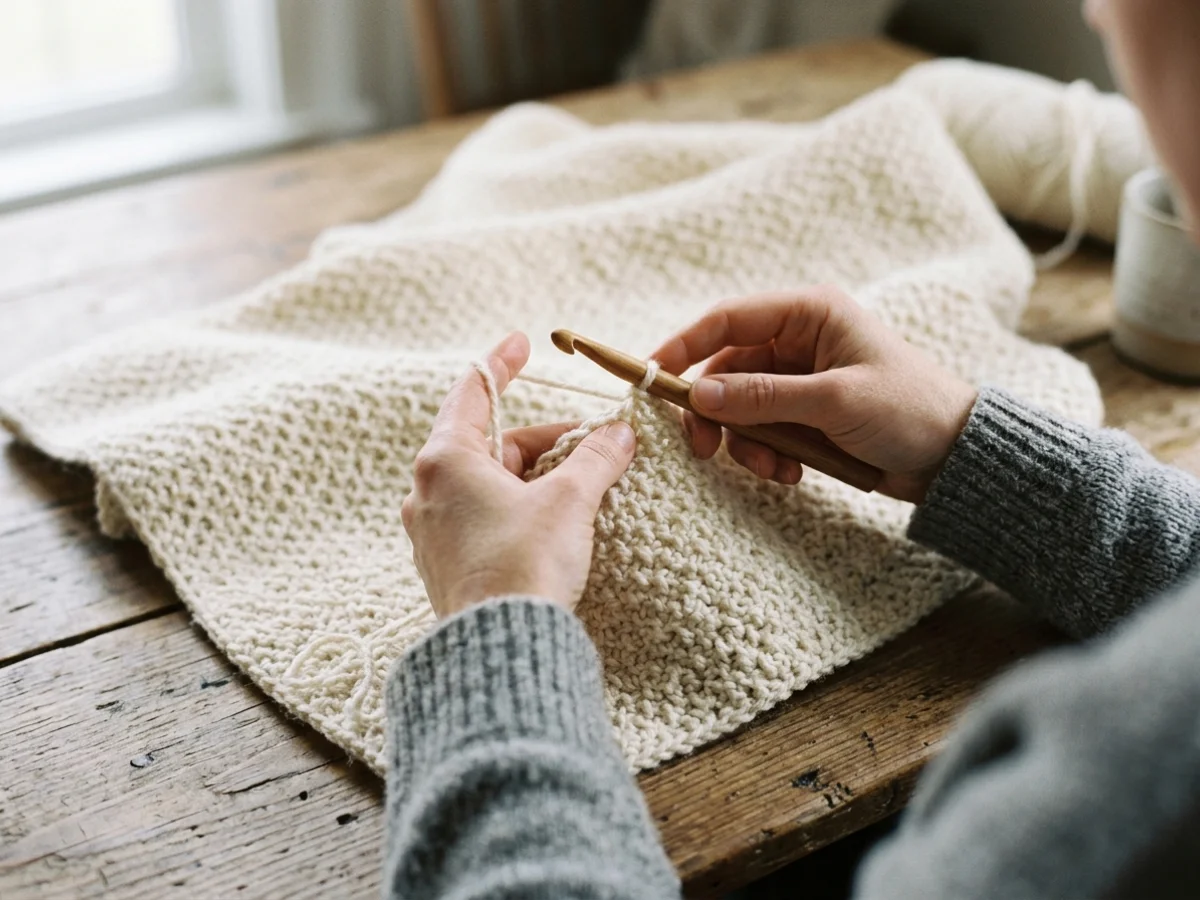
You do not need special tools. A smooth, light colored yarn is the best choice while you learn because you can see where each chain space is. A soft worsted weight acrylic yarn is affordable, comes in many colors and survives the washing machine, which matters for a blanket that will be used every day. The Craft Yarn Council yarn weight system lists worsted as weight 4 if you want to compare labels.
Project at a glance
- Skill level: easy beginner
- Stitches (US terms): chain (ch), single crochet (sc), slip stitch
- Yarn: worsted weight (weight 4), amount worked out by weighing (see below)
- Hook: 5 mm (H-8) or 5.5 mm (I-9), or the size on your yarn label
- Starting chain: any even number
- Extras: yarn needle, scissors, tape measure, two stitch markers
- Worsted weight yarn in one or more colors
- A 5 mm or 5.5 mm crochet hook
- Two stitch markers or scraps of contrast yarn
- A blunt yarn needle for weaving in ends
- A tape measure and a simple kitchen scale
How to Work Out Your Starting Chain
Moss stitch is worked over an even number of chains, and that is the only rule. The easy way to choose the right number is to make a small swatch first. Chain about 30, work the rows below for about 4 inches, then lay it flat and count how many stitches fit in 4 inches. Count each single crochet and each chain 1 space as one stitch each. Divide by 4 to get your stitches per inch.
Now multiply your stitches per inch by the width you want and round to the nearest even number. That is your starting chain. For example, if your swatch shows 4 stitches per inch and you want a 40 inch wide throw, you chain 160. The table below uses that same example gauge of 4 stitches per inch, so treat it as an illustration and use your own gauge for your real blanket.
| Blanket (width) | Example starting chain at 4 sts per inch |
|---|---|
| Baby or stroller, 30 in | 120 |
| Lap throw, 40 in | 160 |
| Large throw, 50 in | 200 |
| Twin bed topper, 60 in | 240 |
A tight foundation chain is the most common reason a moss stitch blanket pulls in at the bottom edge. If your chain feels tighter than your rows, make the chain with a hook one size larger, then switch back to your normal hook for Row 1.
Step by Step: The Moss Stitch Rows
All terms are US. The turning chain 1 at the start of each row does not count as a stitch. Each row has the same number of stitches as the row before, counting single crochets and chain 1 spaces together.
- Foundation: chain an even number.
- Row 1: single crochet in the 2nd chain from the hook. *Chain 1, skip the next chain, single crochet in the next chain.* Repeat from * to the end. Turn.
- Row 2: chain 1. Single crochet in the first single crochet, single crochet in the first chain 1 space. *Chain 1, skip the next single crochet, single crochet in the next chain 1 space.* Repeat from * until one single crochet remains, then single crochet in that last stitch. Turn.
- Row 3: chain 1. Single crochet in the first single crochet. *Chain 1, skip the next single crochet, single crochet in the next chain 1 space.* Repeat from * until 2 stitches remain, then chain 1, skip the next single crochet and single crochet in the last stitch. Turn.
- Repeat Rows 2 and 3 until the blanket is as long as you want.
Here is how the numbers work so you can check yourself. If you chain 160, Row 1 has 80 single crochets and 79 chain spaces, which is 159 stitches. Row 2 starts and ends with two single crochets side by side and has 78 chain spaces in between. Row 3 goes back to the Row 1 layout. Every row stays at 159 stitches, so if you count a different number, look for a skipped or doubled stitch at the edges.
How to Keep the Edges Straight
Almost every moss stitch problem happens in the first two or last two stitches of a row. The easiest fix is to place a stitch marker in the first and last stitch of every row as you work it. On the next row you will know exactly where to put your final stitch instead of guessing at the turning chain.
Count your stitches every few rows, at least until the rhythm feels natural. A blanket that slowly gets wider has extra stitches at the edges; one that gets narrower is missing its last stitch. Catching that in the next row costs a minute. Catching it twenty rows later means pulling out an evening of work.
How Much Yarn Will You Need?
Yarn use depends on your yarn, hook and tension, so the most honest way to plan is to weigh. Weigh your first ball, crochet about 10 rows at your full blanket width, then weigh the ball again and measure how tall those rows are. The difference in weight is what those rows used.
Then scale it up. If 10 rows used 60 g and measured 2.5 inches, a 50 inch long blanket needs 60 x (50 / 2.5) = 1,200 g. Add about 10 percent for the border and for safety, which brings it to about 1,320 g. Buy all your yarn from the same dye lot if you can, because colors can shift slightly between lots.
Changing Colors and Adding Stripes
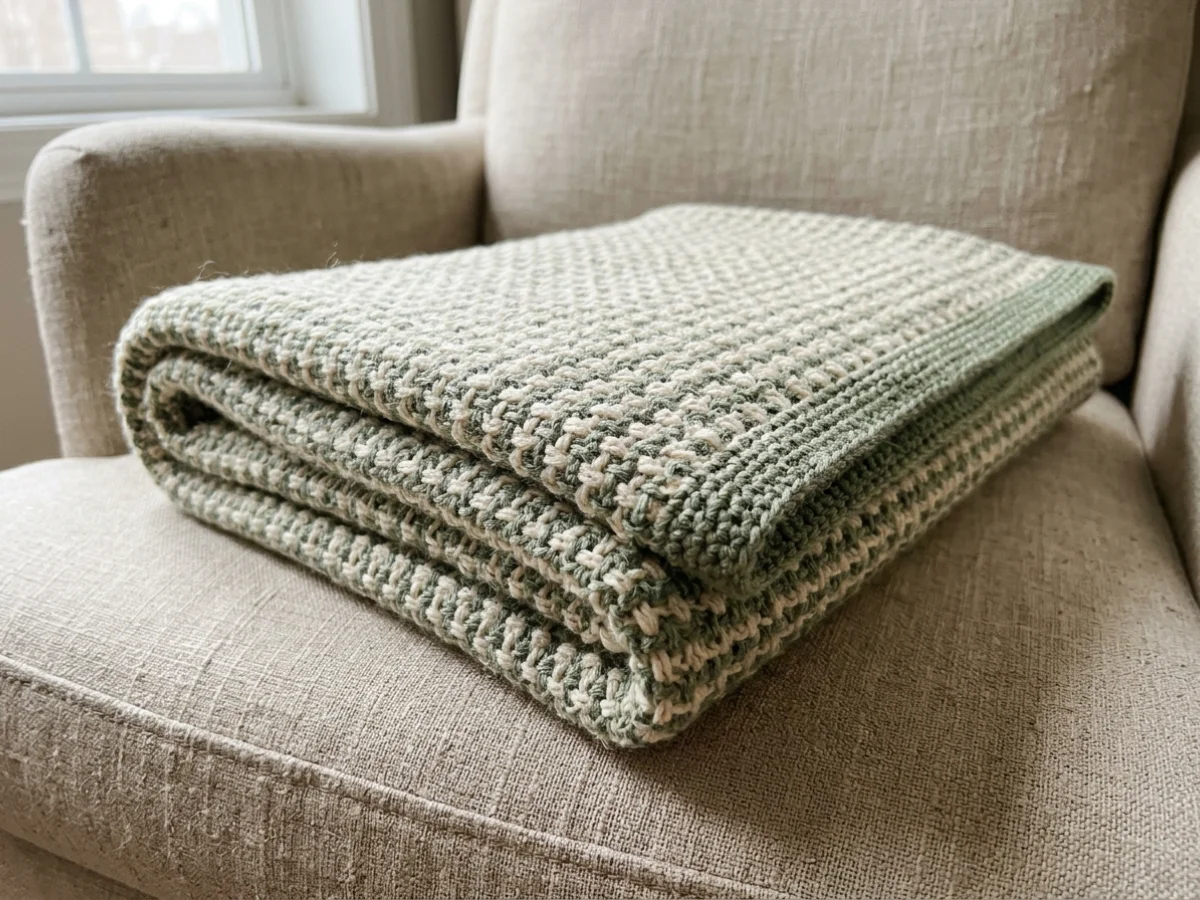
Moss stitch looks lovely in stripes because each color change makes a crisp, slightly speckled line. To change color neatly, work the last single crochet of the row in the old color until two loops are left on the hook, then pull the new color through to finish that stitch. Turn and carry on with the new color.
Change colors on an even number of rows, such as every 2 or 4 rows, so color changes always happen at the same edge. You can then carry the unused yarn loosely up the side instead of cutting it each time, which means fewer ends to weave in later. The border will cover the carried strands.
Adding a Simple Border
A border makes the edges look tidy and hides any small wobbles. The simplest one is a round of single crochet. Work single crochet evenly along each side and put 3 single crochets into each corner stitch so the corners lie flat. Along the side edges, about 1 single crochet into the end of each row works well for moss stitch. Join with a slip stitch to the first stitch.
If the edge ruffles, you are adding too many stitches, so skip one now and then. If it pulls in, add one now and then. For a wider frame, repeat the round 2 or 3 times, still with 3 stitches in each corner. If you enjoy borders and color, a granny square blanket is a good next project because it uses the same corner idea.
Common Moss Stitch Mistakes and Fixes
The first mistake is working into the single crochet instead of the chain space. Moss stitch only works if every new single crochet goes into a chain 1 space below. If you see a stitch stacked directly on top of another one, pull back to that spot and move it into the space.
The second mistake is losing the last stitch at the end of a row, which makes the blanket narrow slowly. Stitch markers in the edge stitches solve this. The third is a tight foundation chain, which pulls the bottom edge in, and a larger hook for the chain fixes it. Finally, changing hook size midway, or picking up a different brand of yarn, can change the width, so finish the blanket with the same hook and yarn you started with.
Frequently Asked Questions
Is moss stitch good for a first crochet blanket?
Yes. It only uses chains and single crochet, it is easy to count and the texture hides small tension differences. If you are brand new to crochet, practise the basic stitches with our crochet for beginners starter guide first.
Is moss stitch the same as linen stitch?
In crochet, yes. Moss stitch, linen stitch, woven stitch and granite stitch are names for the same single crochet and chain 1 repeat. Knitting has a different stitch called moss stitch, so check the craft when you read a pattern.
Why is my moss stitch blanket getting wider?
Usually an extra stitch is being added at the edges, often by working into the turning chain. Count your stitches, mark the first and last stitch of each row, and make sure each row matches the one below.
Does moss stitch use a lot of yarn?
It uses more yarn than open, lacy stitches because the fabric is dense, but less than solid rows of single crochet. Weigh a few rows of your own blanket to know exactly how much you need.
Can I make a baby blanket in moss stitch?
Yes, the dense fabric and small holes make it a good choice. See our guide to a crochet baby blanket for beginners for sizes, yarn and safety tips.
Want more texture? Once moss stitch feels easy, try the soft, raised bumps in our puff stitch for beginners guide.
The Bottom Line
A moss stitch blanket is the perfect step up from plain single crochet. Chain an even number, alternate single crochet and chain 1, put every new stitch into a chain space, and count your stitches as you go. Make a swatch, let your own gauge decide the starting chain and weigh a few rows to plan your yarn. With stitch markers on the edges and a simple border at the end, you will finish with a flat, textured blanket that looks handmade in the best way.